
Fun fact—if you type “sit in square” into Google, 18 of the top 20 hits (and 26 of the top 30 hits) are all about how cats love to sit inside squares, or boxes, or defined areas! So, what is all the fuss about?
If you’ve ever wondered why cats sit in squares or gravitate towards clearly defined areas, you’re not alone. Let’s take a look at why cats like tight spaces so much.
Understanding Body Awareness in Cats
As specialist hunters, cats naturally have a good sense of spatial awareness—and this plays a key role in why cats like small spaces so much.
We know cats can use complex spatial information to track and locate objects when they move out of sight (Fiset & Doré, 1996). For example, they can even demonstrate a mental spatial awareness that allows them to map their caregiver’s location in the house based on the sound of their voice (Takagi et al 2021).
Recently, Péter Pongrácz (Pongrácz 2024) from the University of Budapest published a study exploring how cats understand and develop a mental image of their own body size. Being able to avoid and negotiate obstacles, balance on narrow ledges and navigate small openings are all important abilities for successfully moving around in an environment. How this is done may be through trial and error, learning from experience (which may not involve any mental image of the individual’s body size) or may involve “body mapping”.
Body mapping refers to an individual developing a mental image of their body size/shape to allow them to “judge” how and where is safe to move. The study aimed to explore whether it is this body mapping or self-representation that cats use.
The Study: How Do Cats Judge Space?
The study took place in various home environments with cats and examined how they approached openings of different sizes. Specifically, the aim was to determine their ability and speed or hesitancy when passing through (or attempting to pass through) openings in a sheet of cardboard. This kind of behaviour would help explain why cats like tight spaces and why they are so confident navigating areas that might seem restrictive to other animals.
These spaces included:
- Openings of various widths (5 – 13cm, with a fixed height of 50cm)
- Openings of a fixed width (15cm) but of various heights (15 – 43cm)
In contrast to dogs, the cats showed no hesitancy in approaching and attempting to pass through even the narrowest gap (5cm), which they could squeeze through even though it was narrower than their body width at the shoulders. However, they did show hesitancy when faced with an opening that was shorter than their height at the shoulders—and the hesitancy was more pronounced for taller cats. This suggests cats do indeed possess body mapping or self-representation abilities.
Why Are Cats So Good At Squeezing Through Spaces?
The explanation for this behaviour lies in cats’ physical traits.
Cats are generally slow-moving, highly agile, and very flexible. They also have small unattached collar bones (clavicles) meaning they can squeeze through very narrow gaps. As a result, the cats appeared happy (were not at all hesitant) about approaching and exploring even a very narrow opening, provided it was tall enough. This flexibility partially helps explain why cats confidently explore areas that might seem too small at first glance.
In contrast, dogs move about their environment at much greater speed and are less flexible. So, with body mapping, they would naturally be more hesitant about approaching a narrow opening as there may be a higher potential for harm.
The Role of Whiskers
Cats are also aided by their large, sensitive whiskers (vibrissae), which help them detect and negotiate objects and may help them judge the width of openings as they get very close. Together, the cat’s agility, flexibility, and ability to use vibrissae to assess gap widths mean they are happy to approach even very narrow openings to actively see if they can pass through.
However, the cats were shown to use body mapping to judge that the lower heights of the shortest openings made passage through them challenging. Alternative routes were sought in these scenarios, suggesting they probably possess multiple forms of body awareness.
Why Cats Love Small Spaces
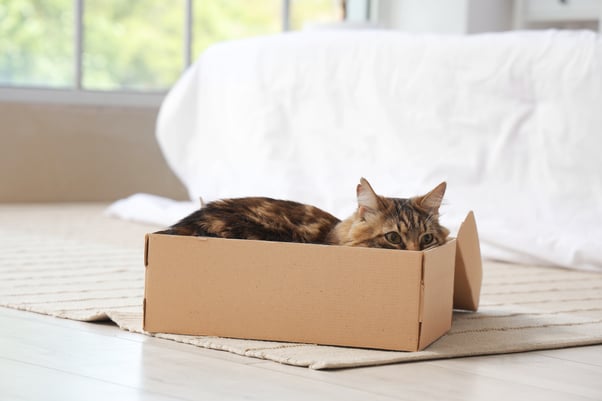
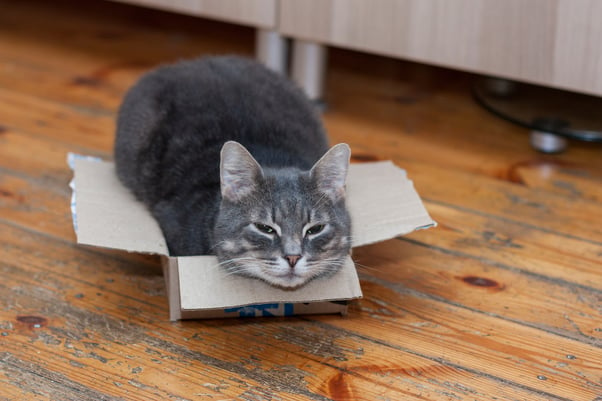
Another interesting aspect of spatial awareness in cats is their well-recognized love of sitting or curling up in small tightly enclosed spaces—such as cats that enjoy cardboard boxes, sinks, laundry baskets, and other containers.
It is thought that our feline friends enjoy these small, enclosed spaces simply because they provide a safe, cozy space and somewhere to hide away and rest. Presumably, if the cat can feel the walls of the cardboard box around it when they curl up, that increases the sense of security. After all, if they are in an enclosed space, it is highly unlikely that another animal would be able to creep up on them while they are asleep.
For cats in both shelters and veterinary hospitals, it has also been shown that having a box to hide away in significantly reduces stress levels—especially when the box is placed higher up off the ground.
The Viral “Cat Square” Phenomenon
In a study published in 2021, Gabriella Smith and her colleagues at the University of New York explored a social media phenomenon known as #catsquare. Many people reported that their cats would choose to sit inside a small square (or other shaped) outline taped to the floor (Smith et al 2021).
This prompted the authors to investigate the phenomenon further by recruiting cats and cat parents to a study in their home environment. Here, cats were exposed to:
- A Kanizsa square illusion on the floor (corners of square marked by “Pac-Man” shape pointing inwards)
- A Kanizsa control (corners of square marked by “Pac-Man” shape pointing outwards)
- A simple black square outline
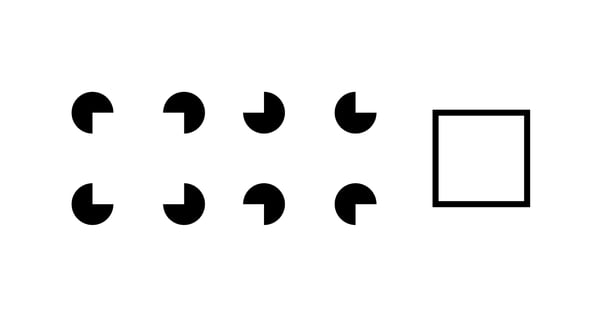
Cats were exposed to different pairs of the shapes on different occasions and videoed. A positive response was recorded if the cat sat or stood for at least a few seconds within the contours of the shape in the first five minutes after entering the room.
Interestingly, the study found that cats would much more often choose to sit or stand inside the square outline or Kanizsa square illusion than in the Kanizsa control. This suggests cats are susceptible to optical illusions, and also confirms that they often do respond to a two-dimensional square shape on the floor.
And in terms of answering the question of why cats sit in squares, it’s probably an extension of their interest in exploring and being inside a small, confined space!
Endlessly Fascinating Creatures
As always, cats continue to surprise us. Whether it’s their ability to mentally map their bodies, navigate tight spaces, or sit inside an imaginary square, they remain endlessly complex—and especially fascinating.
If you’re keen to learn more about your cat’s behaviour and how to support their well-being, keep exploring the FELIWAY blog. And while you’re here, don’t forget to sign up for our newsletter for expert tips, advice, and the latest insights delivered straight to your inbox!
Further reading:
Fiset S, Doré FY. Spatial encoding in domestic cats (Felis catus). J Exp Psychol Anim Behav Process. 1996 Oct;22(4):420–37. doi: 10.1037//0097–7403.22.4.420
Takagi S, Chijiiwa H, Arahori M, Saito A, Fujita K, Kuroshima H (2021) Socio-spatial cognition in cats: Mentally mapping owner’s location from voice. PLoS ONE 16(11): e0257611. https://doi.org/10.1371/journal.pone.0257611
Pongrácz P. Cats are (almost) liquid!-Cats selectively rely on body size awareness when negotiating short openings. iScience. 2024 Sep 17;27(10):110799. doi: 10.1016/j.isci.2024.110799
Smith GE, Chouinard PA, Byosiere SE. If I fits I sits: A citizen science investigation into illusory contour susceptibility in domestic cats (Felis silvestris catus). Applied Animal Behaviour Science. 2021. 240,105338. doi.org/10.1016/j.applanim.2021.105338